Cultural Paradigm
OVERVIEW
Historically, the idea of culture was clearly normative. The word “Culture” is derived from a french expression, which in turn originates from the Latin ‘colere’, which means growing and inclining to the earth and grow (Zimmermann 2017). Matthew Arnold said that the culture is a chase of thoughts and ideas that has been said in the world and by this understanding we can transform them into our concepts and behaviour (Johnson 2018).
What is Culture?
Culture is an umbrella that includes social behaviours and standards found in human social orders, as well as the information, convictions, beliefs, customs, traditions, attitudes, hierarchies, religion, values and motives (Zimmermann 2017). Culture is very essential, and it plays a vital role in your daily life. There are two types of Culture, National and Organisational culture;
What is National Culture?
National culture is a set of norms, beliefs that differs from other countries. Hofstede’s cultural dimensions became a framework for comparing cultures and understanding cross cultural differences (Hofstede 2019). These cultural dimensions of Hofstede highlight the independent preferences of one with other that differentiates countries from each other (Hofstede 2019).
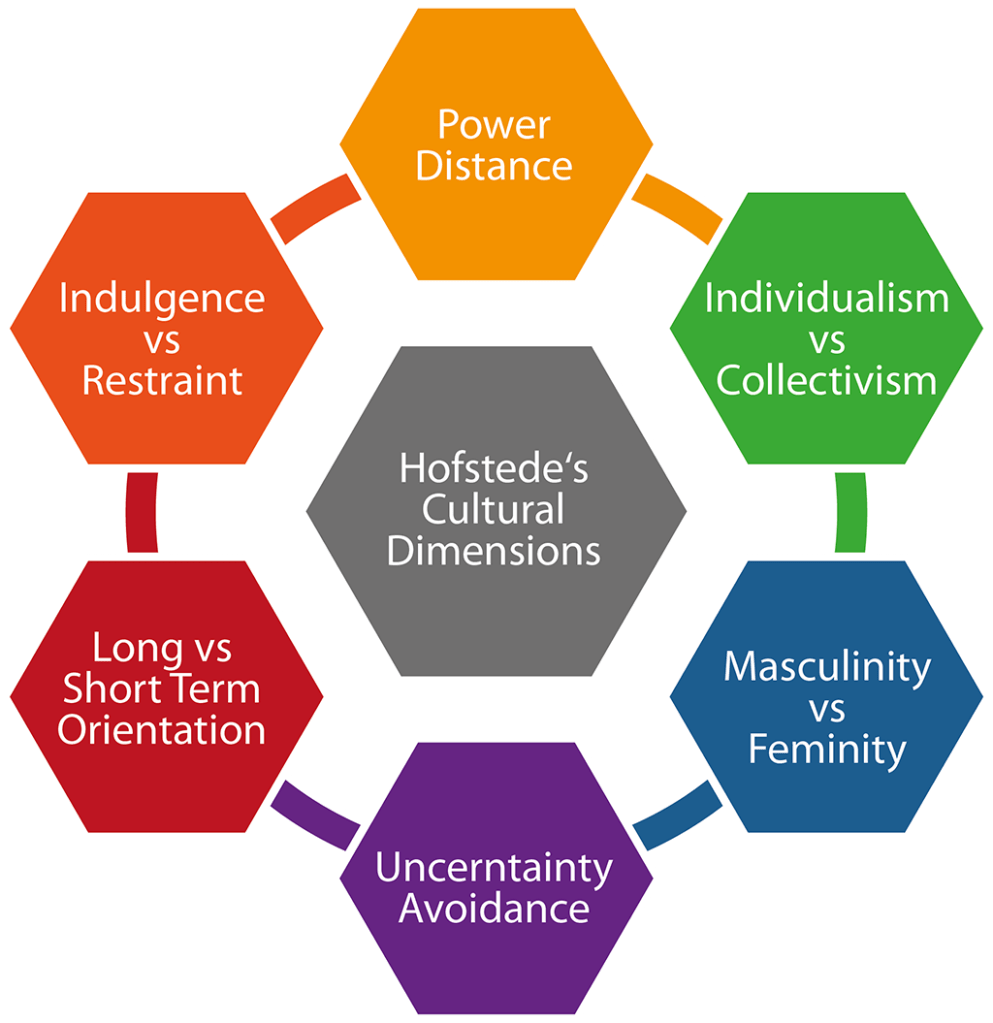
I will take Apple as an example to explain the hofstede’s cultural dimensions. Apple is an American company and is also operating in UK. We can identify the national cultural differences between America and UK by hofstede’s cultural dimensions.
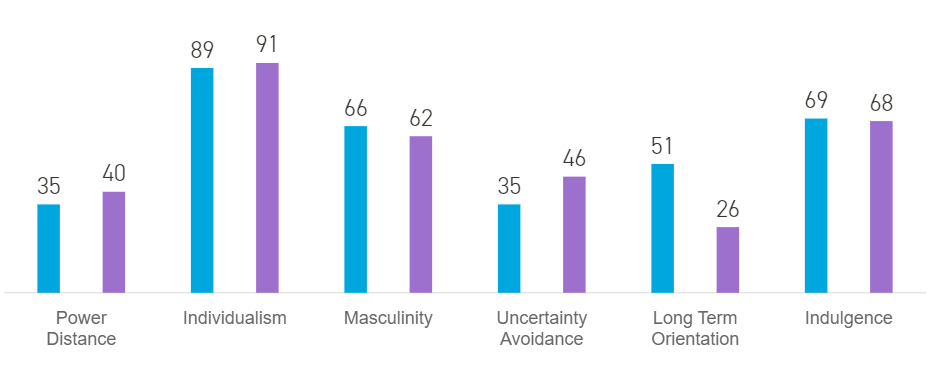
UNITED KINGDOM
USA
POWER DISTANCE
UK is a society that believes that inequalities should be finished in their country, whereas has a high PDI which means that the power is distributed unequally, and a society’s inequality is recognised by the followers as much as by the leaders (Hofstede 2019).
INDIVIDUALISM
UK and USA both have the highest score in individualism, the people are more private in this country and which means that people only look for themselves and their direct families, employees only works for mutual advantage, and the management is the management of individuals (Hofstede 2019).
MASCULINITY
USA is a masculinity society, which means they live in order to work. they are more decisive, focuses on performance and fights the competitions. In UK, at 66 means that UK is also a success driven country and organisations are high performance ambition and focuses on creating more equity (Hofstede 2019).
UNCERTAINTY AVOIDANCE
In UK, UCI is low which means Top managers are involved in the strategy and power of superior is dependent on position (Oliver 2011). The US scores are low which reflects their national culture as a fair degree of acceptance of new innovations, products and has the power to try different technology or practices (Hofstede 2019).
LONG TERM ORIENTATION
In UK, LTO is halfway which means a leading partiality in British culture cannot be examined. In USA, LTO is low which shows that Americans are susceptible to analyse new information to check whether it’s true or not (Hofstede 2019).
INDULGENCE
Uk is more classified as indulgent as they are more optimistic, and they give high degree of importance on leisure time and enjoy their life. In USA, LTO is low and has a restraint culture (Hofstede 2019).
What is an Organisational Culture ?
Organisational culture is the aspect and visible personality originated within every organisation. Even if you are not aware with many companies like Google or Virgin, but their big names reflect the taste of their places of work, their values and the principles of the company (Morcos 2018).
The day to day activities of an organisation that are followed consciously or subconsciously, reflects the organisational culture (Ashby 2000). Your organisational culture reflects how you do business for yourself and others and how do you interact with others, how your team interacts with the outside world, primarily your clients, staff, vendors, media and all other stakeholders. Strong culture leads to ongoing engagement of employees of an organisation and can forecast current and future financial performances (Ashworth 2015).
APPLE’S ORGANISATIONAL CULTURE
For this assignment I will use Apple as an example, Apple is a Multinational company based in America. It was established by Steve Jobs, Steve Wozniak and Ronald Wayne in 1976. Apple is one of the largest companies in the world that manufactures and sells electronics, computer software and other online services. It is the second largest phone manufacturer in the world after Samsung (Toppr n.d).
Apple’s organisational culture is the key factor that lead the company to such great success. Organisational culture of Apple during Steve job’s period was known as harsh and demanding, as he was a very strict leader and wanted everything to be on point and perfect. Charles has explained the organisational culture by its handy model
Charles Handy, defined four different kinds of culture: Power, Role, Task and Person.
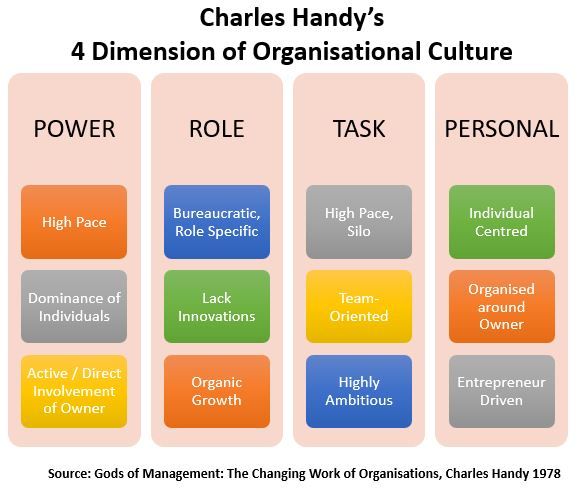
APPLE was known as a power culture during Steve jobs period because he was very dominant, and he used to make every decision and had strict rules and regulations. When Steve Job was serving as the CEO of Apple, teamwork was the priority to take company to the highest level. Steve Job was a high maintenance co-worker who always demanded excellence from his employees. He resigned from Apple in 1985 after losing a boardroom battle for control of the company, imagine the person resigning from the company he founded? (Oliver 2015). But when he came back in 1997, after his company NeXt was bought by Apple, he implemented his personal culture in the organisation. He focused on making beautiful objects that made money. Steve Job was considered as the most valuable assets of the company (Times USA 2019). He was able to combine his unchangeable, persistent passion with a development in management style to create one of the most successful company in the world (Tetzeli 2015). After Steve job’s death, Apple company is still following a centralised structure in which every decision is made by the CEO of the company or his close associates (Tasnim 2018). Apple’s organisational cultural is really inspired by innovation. Apple has a main aspect in their culture, which is secrecy and Tim has put a lot of efforts and time in making the working conditions and environment of the organisation happy. Employees work in pressure because of high competition and it will remain a part of working environment and culture (Pratap 2019). A reflection of Apple’s culture is mainly a mixture of Task and Personal culture because people are considered special and distinctive to the organisation and is more like a bundle of employees working together for one organisation.
CONCLUSION
Thus, Apple has developed a rich and healthy organisational culture. Today, Apple is one of the most successful company, it could never be this successful if Steve job would not have created such strong organisational culture. Apple is undoubtedly effective but can also be more by using adhocracy practices. There should be some little amendments like, employees should also be allowed in the decision-making process as this help them understand goals more effectively and will work more closely on it.
REFERENCES
Ashby, F. C. (2000) Revitalize Your Corporate Culture. New Delhi: Prentice-Hall of India Private Limited.
Ashworth, P. (2015) Why Company Culture is So Important to Business Success [online] available from https://www.linkedin.com/pulse/why-company-culture-so-important-business-success-peter-ashworth/ [15th February 2020]
Dormehl, L. (2018) Tim Cook vs Steve Jobs: Who is Apple’s best CEO ever? [online] available from https://www.cultofmac.com/543227/tim-cook-vs-steve-jobs/ [23rd February 2020)
Hofstede Insights (2019) Country Comparison [online] available from https://www.hofstede-insights.com/country-comparison/the-uk,the-usa/ [23rd February 2020]
Hofstede, G. (2019) The Six Dimensions Of National Culture: Hofstede insights https://hi.hofstede-insights.com/national-culture
Meyer, P. (2019) Apple Inc.’s Organisational Culture & Its Characteristics (An Analysis) [online] available from http://panmore.com/apple-inc-organizational-culture-features-implications [23rd February 2020]
Morcos, M. (2018) Organization Culture: Definition and Trends [online] available from https://www.researchgate.net/publication/329140215_ORGANISATIONAL_CULTURE_DEFINITIONS_AND_TRENDS [15th February 2020]
Oliver, S. (2015) Steve Jobs left Apple on his own, wasn’t forced out, Wozniak says [online] available from https://appleinsider.com/articles/15/09/13/steve-jobs-left-apple-on-his-own-wasnt-forced-out-wozniak-says [23rd February 2020]
Pratap, A. (2019) An Analysis of Apple’s Organizational Culture [online] available from https://notesmatic.com/2017/05/an-analysis-of-apples-organizational-culture/ [23rd February 2020]
Tasnim, M. (2018) ‘An Organisational Analysis on Apple’. European Journal of Business and Management, [online] Volume (10), 36. available from https://pdfs.semanticscholar.org/43e8/06c4c4e68f14b1d3463c8763613213ba4321.pdf [23rd February 2020]
Times USA (2019) The Apple Revolution: 10 Key Moments [online] available from http://content.time.com/time/specials/packages/article/0,28804,1873486_1873491_1873461,00.html [23rd February 2020]
Toppr n.d. Company overview of Apple, Intel [online] available from https://www.toppr.com/guides/commercial-knowledge/business-organizations/company-overview-of-apple-intel/ [23rd February 2020)
 Ayesha's Blog
Very nicely explained about the organisational culture.
LikeLiked by 1 person
Thank you so much for your time 🙂
LikeLiked by 1 person
Nice work 👏🏻
LikeLiked by 1 person
Thank you so much for your feedback 🙂
LikeLiked by 1 person
V nicely elaborated!
LikeLiked by 1 person
Thank you so much for your feedback. 🙂
LikeLiked by 1 person
Very nice 👍🏻
LikeLiked by 1 person
Very nice work, the way you have explained both cultures are very impressive. Your blog looks really attractive and knowledgeable. 👍🏻
LikeLiked by 1 person
Hey Shehroz, Thank you for giving me the feedback and I’m glad that you find it knowledgeable! 🙂
LikeLiked by 1 person
Culture is hard to understand but you’ve given a beautiful and a clear view of it, it is very much understanding. And I agree with the organisational culture of Apple, Steve job was the only person who made Apple a successful company.
LikeLiked by 1 person
Yes indeed, Steve job did a lot of handwork to achieve this success. Thank you for your feedback 🙂
LikeLiked by 1 person
Hey ayesha, I believe culture can be managed within an organisation if the leader is effective, just like Steve job. The way he maintained Apple was impressive and inspiring. If every other organisation adopts his style and skills, then no force can stop you from being successful. Anyways your blog looks quite attractive and very much appreciative.
LikeLiked by 1 person
Hey shaharyar, I agree with your point. People should definitely adopt his style because he gave everyone a new vision in terms of effective working style. Well I’m glad you find it attractive, thank you so much for your feedback. 🙂
LikeLiked by 1 person
Hey, I also believe that culture can be managed in an organisation just like steve job did, you only need to have the courage to maintain it. I find your blog interesting and knowledgeable, great work.
LikeLiked by 1 person
Thank you for telling about your views too, I’m happy that it was informative for you. 🙂
LikeLiked by 1 person
Cultures are difficult to be managed in some organisations, but I feel they need to be followed because Culture are important. Your blog is quite interesting and informative too, I really like it.
LikeLiked by 1 person
Hey Aima, you are right because cultures reflect our beliefs, customs, traditions, values and many more. So it needs to be followed by Organisations. Thank you for your feedback 🙂
LikeLiked by 1 person